The Mitre and the Sleigh: Interpretation Notes for December 2026
December is the busiest month in many heritage settings, and the temptation to simplify is understandable. A red suit is instantly recognisable; a fourth-century bishop in eastern Mediterranean dress is not. Yet when churches, museums and local societies allow St Nicholas to dissolve into Father Christmas, they lose more than historical accuracy. They weaken the patronal story that gives many buildings and customs their distinctive local significance, and they make the heritage case harder to explain to visitors, funders and volunteers.
Two figures, two histories
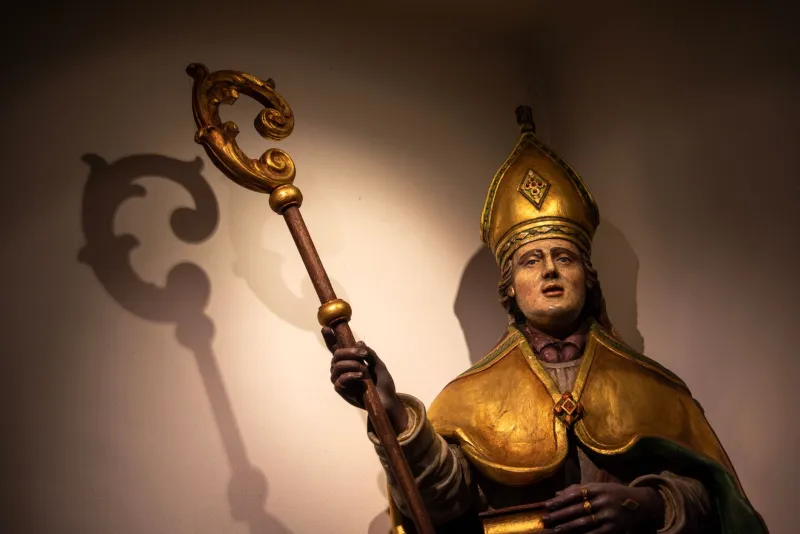
St Nicholas of Myra is a historical bishop of the fourth century, venerated across eastern and western Christianity. His later legends emphasise secret gift-giving, the rescue of sailors, care for children and the defence of the wrongly condemned. His attributes in British church art include the mitre, the crozier, three golden purses or balls, a ship and the three children in a tub. These are not decorative extras. They are the visual grammar by which generations of parishioners recognised the saint and recalled the works associated with him.
Father Christmas is a different figure with a different history. In Britain, the personification of Christmas cheer has roots in seasonal revelry, wassailing and the Victorian reinvention of old customs. The American Santa Claus, shaped by the 1823 poem commonly known as 'A Visit from St Nicholas', by nineteenth-century illustration and by twentieth-century advertising, was later absorbed into British usage. The red suit, the sleigh and the reindeer belong to that modern festive tradition. They are not simply updated versions of the bishop's vestments.
Why blurring weakens the case
For a parish church with a medieval wall painting, a civic museum with a Victorian toy display or a local society mounting a December exhibition, conflation has practical consequences. A medieval carving labelled loosely as 'Santa' becomes a generic seasonal object. Its provenance, date and devotional purpose disappear from the interpretation, and with them the reason it is worth conserving. A charity tradition associated with St Nicholas may be presented as a whimsical precursor to present-giving, rather than as a local institution with its own records, beneficiaries and civic history.
The patronal festival also suffers. St Nicholas's Day on 6 December, and St Nicholas's Eve on 5 December, offer a distinctive opportunity for churches and communities. If the feast is treated merely as an early instalment of Christmas shopping, the patron saint becomes a mascot. The building, the bell tower, the charity board and the parish archive are then interpreted through a commercial lens that fits them poorly.
Label the collection with care
The first task is documentary. Captions should distinguish the saint from the seasonal figure without being pedantic. 'St Nicholas, bishop of Myra, medieval carving' is clearer than 'Santa carving'. A modern figure should be described as 'Father Christmas figure, late twentieth century' or 'Santa Claus ornament, 1990s', with its own date and context. Museum catalogues and parish inventories should treat 'Nicholas, Saint' and 'Santa Claus' as separate subject headings, even where objects are displayed together.
Front-of-house volunteers and stewards need a short briefing. They should be able to point out the mitre, the crozier, the three purses and the ship, and to explain why a medieval St Nicholas may look austere rather than jovial. This is conservation of meaning as much as conservation of fabric. Misidentification can lead to inappropriate treatment: seasonal lights fixed to medieval polychromy, red fabric draped over carved stone, or adhesive labels applied to historic surfaces. Correct interpretation supports correct care.
A family trail that follows the bishop
A well-designed family trail can hold both figures in view without collapsing them. The Society suggests a simple structure for December 2026: six stops, each asking visitors to look rather than merely read. Find the mitre. Count the purses. Locate the ship. Look for the children. Read the parish charity board. Then, at the final stop, ask why Father Christmas looks so different. The answer can be brief: the bishop's legends travelled through many centuries and many countries, and the modern festive figure borrowed some of his themes while developing a separate identity.
Trails should be available in large print and plain English, with versions for younger readers that avoid condescension. In parishes with Welsh, Irish or Scots Gaelic signage, bilingual labelling is worth considering where local policy supports it. The aim is not to turn the nave into a lecture theatre, but to give families a reason to look up from the trail sheet and back at the building.
Staging events without costume confusion
December events should be equally clear. A candlelit service for St Nicholas's Eve, a talk on the parish's charity records, a bell-ringing open evening or a revival of the boy bishop tradition can all make the patronal festival intelligible. If a Santa's grotto is part of the wider civic offer, it is better placed in a separate hall or marquee than in the chancel, and it should be labelled as a modern festive tradition rather than as the saint's own domain. Volunteers dressed as St Nicholas and volunteers dressed as Father Christmas should not be asked to pose together without explanation. Good interpretation does not forbid fun; it simply tells visitors which story they are in.
The conservation argument
Interpretation shapes conservation because it shapes significance. A wall painting, a roof boss, a charity board or a memorial window is more likely to be maintained well when its subject is understood. Funding bids are stronger when they can explain that a St Nicholas dedication connects the building to centuries of local devotion, maritime trade, schooling or poor relief. Local societies preparing December displays for 2026 can help by auditing captions, checking object dates and offering a short training session for stewards.
The red suit need not be banished from the nave. It should be named for what it is. A church or museum that explains the mitre will not lose the sleigh. It will make both figures more interesting, and it will give visitors a clearer account of the local heritage that December is meant to celebrate.