When the Patron Is Missing: Conservation Choices for Vacant Image Brackets
The evidence of an empty bracket
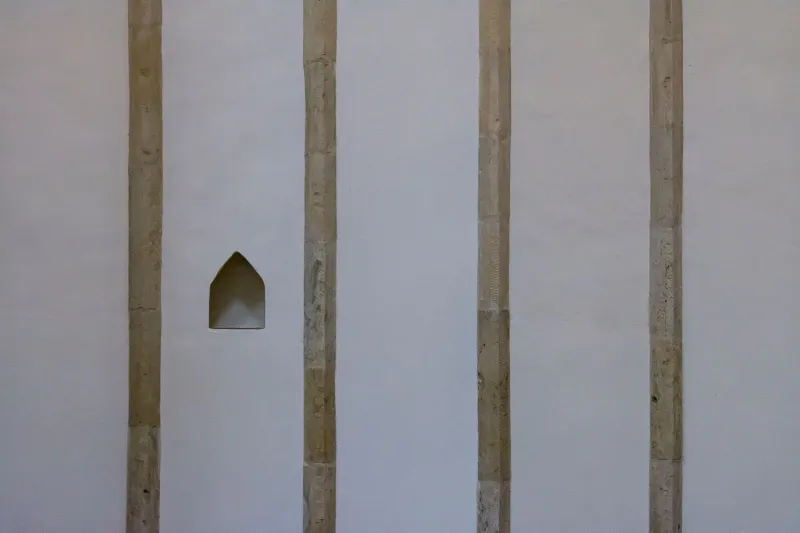
A shallow niche in a nave wall, a corbel cut for a figure that is no longer there, a plinth in a porch with no statue above it: these are common sights in Britain’s St Nicholas churches. They are easily overlooked, and equally easily misunderstood. To a casual visitor an empty niche may look like an unfinished job or a failure of upkeep. To a fabric committee it can feel like a nagging prompt: should something be put back?
The first task is to resist the urge to fill a gap before understanding it. An empty image bracket is not simply a missing object. It is a piece of evidence about the building’s history, about changing attitudes to sacred images, about local patronage, about theft or decay, and about the long sequence of decisions that have shaped the church interior. In conservation terms, absence can carry as much significance as presence. The question for 2026 is not only what a parish should put in a niche, but what it should do with the story the niche already tells.
Why niches stand empty
The causes are varied, and local records usually reward patient enquiry. The Reformation of the sixteenth century removed or covered many images in English churches, and subsequent visitations and episcopal instructions affected others. The Civil War and Commonwealth period brought further disruption in some places. Later changes were often less dramatic but equally consequential: Georgian and Victorian reorderings, the removal of allegedly unsafe fittings, damp and stone decay, theft, and the well-meant clearance of apparently redundant furnishings.
A vacant bracket may therefore commemorate a lost medieval rood, a patronal figure, a side-altar image or a nineteenth-century devotional addition. It may also be a fragment of a larger scheme that was never completed. Churchwardens’ accounts, faculty papers, diocesan archives, antiquarian drawings and early photographs can all help. So can the fabric itself: tooling marks, fixing holes, discoloured stone and the shadow of a former canopy often say more than a guidebook. Volunteers should record what they see before any cleaning or repair is undertaken, and should keep photographs with a date and a note of the photographer.
Three legitimate approaches
Parishes generally face three broad choices, and none should be adopted as a default.
The first is to commission a new figure. This can be appropriate where the niche is structurally sound, where the original scheme is well understood, and where a contemporary work of art can be clearly distinguished from historic fabric. A new image should not pretend to be medieval. It should be designed for the space, made of suitable materials, fixed reversibly where possible, and accompanied by a faculty or other required consent. The Diocesan Advisory Committee should be involved early, not after a faculty application has been drafted. A commission also raises questions of security, insurance and long-term maintenance, which are better answered before an artist is appointed than afterwards.
The second is to leave the absence visible and interpret it. This is often the most honest option, particularly where the original figure cannot be reconstructed with confidence. A simple, well-designed panel can explain what is known, what is uncertain and why the niche is empty. The absence then becomes a teaching point rather than an embarrassment. Care is needed to avoid overclaiming: ‘probably removed at the Reformation’ is not the same as ‘destroyed by iconoclasts in 1547’. Local evidence should govern the wording.
The third is a hybrid: retain the empty niche as the primary evidence, but introduce a small, reversible focus such as a temporary icon, an exhibition panel or a piece of interpretative lighting for the patronal festival. This approach can suit churches where a permanent commission would be inappropriate but where the niche deserves to be noticed. It also allows a parish to test public response before committing to anything more substantial.
Conservation ethics in practice
The governing principles are familiar but worth restating for fabric committees. Minimum intervention is usually preferable to reconstruction. New work should be reversible where practicable and should not obscure historic fabric. Any addition should be distinguishable from the original, whether by date, material, design or documentation. Records of all work should be deposited with the parish and, where appropriate, the diocesan records office. These principles do not forbid new art; they require that new art be honest about itself.
Pastiche is the particular risk. A newly carved St Nicholas in a neo-Gothic niche may be sincere, but it can confuse future historians and mislead visitors about the building’s development. A clean modern figure, or a clearly dated interpretation panel, often serves the church better. Where a faculty is required, the parish should expect the DAC to ask about design quality, fixing methods, lighting, security and maintenance. These questions are not obstacles; they are the normal discipline of caring for a listed building.
A practical checklist for volunteers
Before a parish decides what to do with a vacant niche, it should assemble a small evidence file. This need not be elaborate. A measured sketch, a set of photographs, a note of the stone type and condition, and a short summary of any documentary references will give the fabric committee a sound basis for discussion. The churchwardens should check the terrier and inventory, and the parish should consult the diocesan archives for faculty papers and earlier correspondence.
It is also worth asking what the niche was for. Was it a focus for private prayer, a patronal image, part of a reredos or a funerary monument? Does its position relate to a door, a chapel, a guild altar or a prominent sightline? The answer will shape any interpretation. Conservation work should be carried out by suitably experienced practitioners, and any fixing into historic stone should be specified by a conservator or architect rather than devised on site.
Finally, the parish should consider how the niche will be understood on ordinary days as well as feast days. A small label, a leaflet or a QR code linked to a stable parish web page can be more effective than a large board. The St Nicholas Society encourages parishes to use the patronal festival as an occasion for explaining their building’s history, but the interpretation should remain intelligible in January as well as December.
Absence, memory and the patronal festival
For churches dedicated to St Nicholas, a vacant patronal niche has a particular resonance. The sailor’s saint, the protector of children and the bringer of gifts is often represented in stained glass, wall painting and carving, but not always in the place where a figure once stood. That absence can be acknowledged without being dramatised. A short note in the pew sheet, a guided walk after the patronal service, or a small display of photographs and documents can help a congregation see the niche as part of the church’s continuing life rather than a reproach.
The wider heritage sector has become more comfortable with absence in recent years. Interpreters now routinely explain lost roods, whitewashed walls and empty plinths as part of the Reformation and later history. St Nicholas churches can benefit from that approach. The aim is not to make a virtue of loss, but to treat the building as a document. An empty niche is a sentence in that document. The parish’s task is to read it carefully, record it honestly and decide, with proper advice, whether the next sentence should be written in stone, in interpretation or simply in good stewardship.
In 2026, with many congregations reviewing their buildings and their mission, the vacant niche offers a small but useful test of principle. It asks whether conservation is understood as decoration or as evidence; whether new work is undertaken to satisfy taste or to serve the building’s future; and whether visitors are trusted with the full story. A parish that answers those questions carefully will have done more than fill a gap. It will have kept faith with the fabric and with the people who will inherit it.