Workbench Witnesses: A Local Society’s Guide to St Nicholas Guild Altars
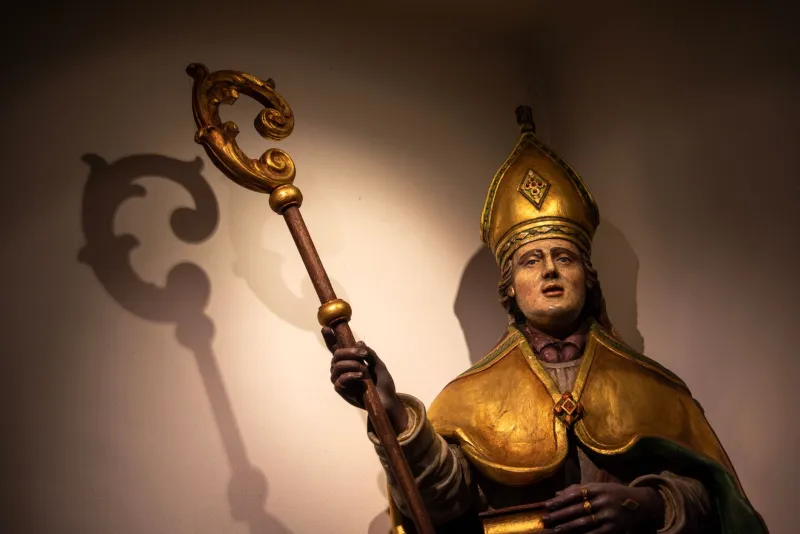
St Nicholas is often introduced as the patron of sailors and children. In the medieval English town, however, he was also a saint of the workshop, the warehouse and the counting house. Craft fellowships and merchant guilds adopted him with striking frequency, endowing altars, lights and chantries in parish churches from York to Bristol. Many of those foundations were swept away in the sixteenth century, but their evidence has not vanished. For local societies in 2026, the guild altar is less a lost object than a research problem with a paper trail.
A Saint for the Bench and the Counting House
The appeal of St Nicholas to organised trades was practical as well as devotional. He was a saint of safe passage, honest dealing and providential rescue: useful qualities for merchants whose goods travelled by sea and road, and for craftsmen whose reputations rested on fair weights and sound work. Guilds of merchants, coopers, brewers, weavers and lesser trades maintained lights before his image, funded obits and, in wealthier towns, established chantry priests to sing for members living and dead.
Apprentices were never passive observers in this system. A young man entering a trade often entered a fellowship whose calendar was punctuated by the patronal feast, whose funds supported sick members, and whose altar was a visible sign of the trade’s standing. The altar therefore did more than honour a saint. It marked a workplace community inside the parish church.
What Survives After the Chantries
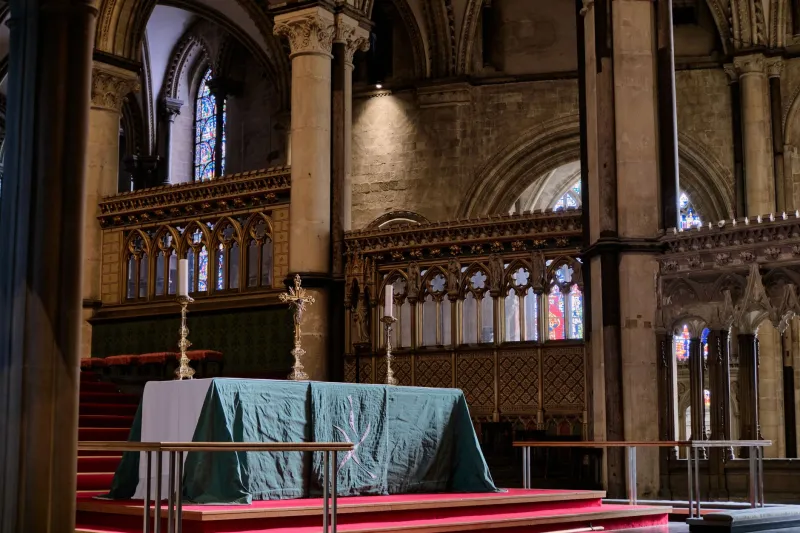
The dissolution of the chantries in 1547 removed the endowments that sustained many guild priests, but the church fabric often retained quieter evidence. A side altar may survive as a stone slab, sometimes marked with five consecration crosses. A piscina in the south wall of an aisle or chapel can indicate where a subsidiary altar stood. Image brackets, screen panels, brasses and incised slabs may preserve a guild’s name or emblem. In some churches, the guild left its mark in the arrangement of aisles and chapels rather than in any single object.
Documentary evidence is equally fragmentary but often more revealing. Wills are the most accessible starting point: a testator may leave money to the light of St Nicholas, to a guild altar, or to a priest serving in a named chapel. Churchwardens’ accounts, guild registers, town records and the returns of the 1389 guild inquiry can supply names, dates and locations. None of these sources is self-explanatory. The task for a local society is to assemble them carefully and to distinguish evidence from inference.
Reading the Building First
A church visit should begin with the obvious aids: the listed building description, the county inventory, Pevsner and the parish guidebook. These will not usually identify a guild altar, but they will establish the building’s phases and the likely position of side chapels. Look for a slab set against a wall, a blocked piscina, a bracket high on a pier, or a screen bay with unusual decoration. Record what is there before consulting the documents, so that the documentary search is not shaped by wishful thinking.
Mason’s marks, tooling and wear patterns can help to distinguish an altar slab from a grave slab or a reused lintel. A faculty or restoration account may explain how an object reached its present position. Photograph the fabric in raking light, note dimensions and draw a simple plan. These are modest skills, but they make a local survey usable by conservation professionals and future researchers.
The Documentary Trail in 2026
Begin at the local record office or archive service with wills proved in the relevant probate court. Search for phrases such as ‘light of St Nicholas’, ‘altar of St Nicholas’, ‘guild of’, ‘fraternity’ and ‘obit’. Churchwardens’ accounts can record payments for wax, repairs to a chapel or the maintenance of a guild image. Town records may mention admissions to a fellowship or leases of guild property. Where a medieval guild return survives, it can confirm the dedication of an altar and the names of wardens.
Online catalogues are useful for orientation, but they rarely replace the original document. In 2026, many record offices still require advance ordering and some collections remain uncatalogued. Keep a research log with document references, dates and exact transcriptions. Where a claim rests on a single will, say so. Where a slab is associated with a guild only by local tradition, label it as tradition rather than fact.
A Community Method
Guild altars are easily overlooked because they sit at the edge of the parish story. A local society can bring them back into view without overstating the evidence. A small display might pair a photograph of an altar slab with a transcript of a will and a plan showing the chapel’s position. A guided walk can pause at the site of a guild altar and explain how a trade fellowship functioned in the town. A school or apprenticeship group can be invited to consider how craft communities once expressed their identity through stone, glass and paperwork.
Conservation follows interpretation. If a slab is vulnerable to foot traffic, the solution may be a simple barrier or a change of route rather than expensive intervention. If a screen panel is fading, environmental monitoring may matter more than cleaning. The first duty is to record accurately and to avoid irreversible treatment.
Reconnecting the Overlooked Altar
The guild altar is a reminder that Britain’s parish churches were once crowded with particular loyalties: trade fellowships, neighbourhood fraternities and families who wanted their names remembered. St Nicholas stood at the centre of many of those arrangements. In 2026, local societies can recover them not by inventing a lost splendour, but by reading the fabric and the archive together. The workbench saint leaves witnesses in stone and paper. They are waiting for a careful eye.