The Bishop in the Limewash: Seven St Nicholas Wall Paintings for a Winter Circuit in 2026
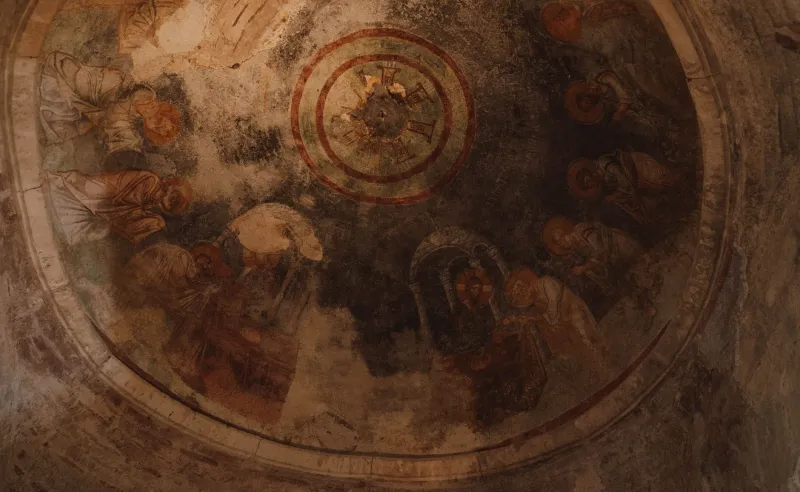
Winter is the connoisseur’s season for wall paintings. In summer, the churchyard hedge is high, the light is broad and the eye is easily distracted by brass and glass. In winter, with the trees bare and the sun low, a faded bishop on a nave wall can seem almost freshly painted. St Nicholas is a natural companion for such scrutiny: bishop, protector of sailors, patron of children and travellers, and a saint whose legends gave medieval painters plenty of human drama to work with.
The images that survive are also among the most vulnerable parts of our church heritage. They sit in buildings that were never designed for central heating, they have survived limewash, reform, neglect and well-meaning repair, and they now face the slower pressures of damp, salts and fluctuating humidity. The seven places below are a selective winter circuit, not a definitive census. In several, the St Nicholas material is fragmentary or known as much from antiquarian records as from visible pigment. All reward a patient visit, and all illustrate why conservation is not a specialist sideline but part of the everyday care of a parish church.
Why St Nicholas Looks Down from So Many Walls
Medieval devotion to St Nicholas was practical. Coastal parishes prayed for his protection at sea; families invoked him for children; travellers sought his aid on dangerous roads. His legends offered painters a ready repertoire: the three young women saved from poverty, the three boys restored to life, the storm calmed, the sailor rescued. The bishop’s mitre and crozier made him instantly recognisable, even when the face had been lost to time.
That recognisability is useful today. A fragment of a bishop in a painted scheme can open a window onto the whole devotional world of a parish. It can also raise immediate conservation questions. Is the plaster stable? Has the painting been treated with wax or varnish in the past? Is the heating regime causing salt damage? Does the parish know what it holds? These are not abstract matters. They determine whether a wall painting can be shown to visitors at all, and whether the next generation will inherit more than a photograph.
Reading the Fragments: A Selective Trail
The following stops are best approached as a winter circuit rather than a literal coast-to-coast itinerary. Opening times vary, and several churches keep their paintings behind glass, in side chapels or under temporary coverings. Members should check parish websites and local benefice notices before travelling, and should never use flash photography where paintings are exposed. A torch with a warm beam and a pair of binoculars are more useful than a camera.
1. St Botolph, Hardham, West Sussex
Hardham is one of the great survivals of English medieval painting, and its early twelfth-century scheme offers the visitor a whole theological programme rather than a single image. St Nicholas belongs within that crowded company of saints and narrative scenes, a reminder that the saint was not isolated in medieval devotion but part of a wider intercessionary landscape. The conservation story here is one of controlled access: the paintings are precious enough to require careful stewardship, and the parish has long experience of balancing visitors with the building’s needs. Winter light is especially kind to the north wall. Visitors should allow time to read the scheme slowly, and should respect any ropes or barriers.
2. St John the Baptist, Clayton, West Sussex
Clayton’s paintings are often admired for their narrative energy, and the St Nicholas material sits within a scheme that repays close looking rather than a quick photograph. The church has worked over many years to stabilise and interpret its wall paintings, and the result is a setting in which fragments can be read without being over-restored. Look for the bishop’s vestments and the traces of gesture that survive where the face has gone. Practical note: the church is small, and winter services may limit access; a weekday visit is usually more rewarding.
3. St Mary, West Chiltington, West Sussex
West Chiltington offers a quieter version of the same story: a parish church with medieval paintings that have survived in part because they were never entirely erased. The St Nicholas figure, where visible, is less a complete portrait than a trace of a devotional scheme. That makes it a good place to think about conservation ethics. The question is not only how to clean a painting but how much intervention is appropriate. The parish’s careful approach allows visitors to see age as part of the image rather than as a fault to be corrected.
4. St Nicholas, Rodmersham, Kent
A church dedicated to St Nicholas is an obvious place to begin looking for him, and Rodmersham rewards the visitor who expects fragment rather than fresco. The dedication and the surviving painted material together show how a parish’s identity was expressed in stone, glass and pigment. Conservation here is a matter of routine vigilance: roofs, gutters and heating matter as much as the painted surface itself. Visitors should check opening arrangements locally and should not assume that a dedication guarantees a visible image. The reward is a sense of continuity rather than spectacle.
5. St Nicholas, Feltwell, Norfolk
Norfolk’s clayland churches preserve a remarkable range of medieval painting, and Feltwell belongs to that wider landscape of survival. The St Nicholas material should be sought as part of a scheme rather than as an isolated panel. In churches of this kind, the conservation challenge is often environmental: damp in the walls, salts in the plaster and the well-intentioned warmth of modern heating can all take a toll. The parish’s long-term care depends on faculty advice, modest funding and patient recording. A winter visit supports that work simply by showing that the building matters.
6. St Mary, Houghton-on-the-Hill, Norfolk
Houghton-on-the-Hill became well known after its wall paintings were rediscovered in the 1990s, and the scheme remains a powerful example of what careful investigation can reveal. St Nicholas appears within a painted programme that has been conserved and interpreted for visitors without being turned into a theme park. The church is a good place to see how conservation and presentation can work together: lighting, glazing and interpretation are all modest, but they allow the paintings to be read. Visitors should respect the building’s opening hours and remember that a rural church is not a museum with a full-time staff.
7. St Peter and St Paul, Pickering, North Yorkshire
Pickering’s medieval wall paintings are among the most ambitious surviving cycles in the north of England, and St Nicholas takes his place among the saints and narratives that cover the nave. The scale of the scheme makes it a fitting northern end to a winter circuit. Conservation here is a long-term project of monitoring and interpretation, and the church has become adept at managing visitors without overwhelming the fabric. The practical lesson for the heritage visitor is simple: come prepared to look, not merely to collect. The paintings are best understood as a whole, with St Nicholas as one voice in a larger choir.
A Responsible Winter Pilgrimage
A winter circuit of this kind should be undertaken with the parish’s needs in mind. Churches are not galleries; they are working buildings with roofs to repair and congregations to sustain. Visitors can help by checking opening times, making a donation, buying a guidebook and avoiding flash photography. Where paintings are covered or roped off, that is a conservation decision, not an obstacle to be overcome.
For 2026, the case for these paintings is straightforward. They are fragile, they are local, and they are easily lost to indifference. A St Nicholas wall painting is not only a medieval image of a saint; it is evidence of how a community once imagined protection, danger and rescue. In a winter church, with the light low and the building quiet, that evidence can still speak. The Society encourages members to visit responsibly, to record what they see and to support the parishes that keep these painted witnesses alive.