Painted Light on the Patronal Trail: Six St Nicholas Windows to Read in 2026
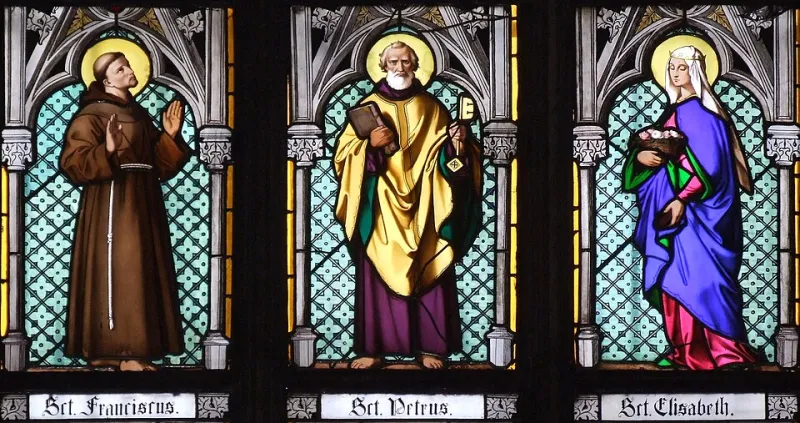
Photo: Oryg. Pudelek, Mody. Albertus teolog, CC BY-SA 4.0, via Wikimedia Commons
St Nicholas is a saint who rewards close looking. His legends are not abstract doctrines but small human dramas: a father saved from selling his daughters, sailors pulled from a storm, children restored to life. In stained glass these episodes become a sequence of signs — three golden purses, a ship, a bishop's mitre — that any visitor can learn to read. The six windows below, spread from Norfolk to Fife, form a manageable trail for 2026. Each is also a conservation story, because glass that has survived centuries is now held in place by lead, stone and the patience of local fundraisers.
How to read a St Nicholas window
In a St Nicholas window, start with the silhouette. A figure in a mitre and carrying a crozier is the saint as bishop. The three purses, often shown as three gold balls or bags, recall the secret dowry he gave to three poor sisters. A ship with a storm-tossed sail identifies him as patron of sailors; a group of children in a tub recalls the legend of the three boys. Pawnbrokers' three balls derive from the same purse story. Look at the bottom of the panel for the donor or inscription, and at the borders for the glass painter's repeated motifs. Then look at the fabric: corroded lead, cracked quarries, rusty saddle bars and water staining in the stone reveal are the enemies of the image.
Norfolk: Blakeney and the Three Purses
At St Nicholas, Blakeney, the saint's charity is set within sight of the salt marsh. The window's lower panels show the three purses; above, a ship rides a stylised sea. The glass is Victorian, but it incorporates earlier fragments, and the north aisle stonework has been the subject of a long-running fabric appeal. In 2026 the church is normally open daily to visitors; those wanting to see the upper lights should ask the parish about access. The local Friends group and the diocesan advisory committee have been working on a scheme of stone repair and protective glazing, with grant applications to the National Churches Trust.
Suffolk: Bury St Edmunds and the Bishop's Mitre
St Nicholas, Bury St Edmunds, offers a lesson in how a window works with its setting. The saint appears in full pontificalia, mitre and crozier, while the panels below show the rescue of the children. The east window's tracery is the real frame; when lead fails, water reaches the glass from above. A 2026 appeal is focused on repointing the parapet and repairing the leaded lights, rather than replacing glass wholesale. The church is usually open on weekdays and for services; visitors should check the parish website for holiday closures.
Kent: Chislehurst and the Storm at Sea
At St Nicholas, Chislehurst, the ship is the central image. St Nicholas leans from the rigging to still the waves, a subject that spoke directly to Kentish coastal and mercantile families. The window's blues are fragile: manganese in the glass has darkened, and some painted detail has flaked. The conservation approach here is cautious — consolidate the paint, re-lead only where necessary, and improve ventilation. The parish is open to visitors on most days in 2026; guided looks at the glass can be arranged through the church office.
Gloucestershire: Gloucester and the Pawnbroker's Sign
St Nicholas, Gloucester, is a city church with a mercantile memory. Its St Nicholas window includes the three golden balls that became the pawnbroker's sign, a reminder that the saint's charity was also a financial story. The building is listed, and the local fabric fund is working through a programme of roof and window repairs. In 2026 the church is open to visitors at advertised times; because the surrounding streets are busy, group visits should be booked. Historic England and the diocesan advisory committee have been consulted on the stonework.
Yorkshire: Beverley and the Children in the Tub
At St Nicholas, Beverley, the legend of the three boys is given unusual prominence. The window shows the children in a wooden tub, a scene that can look strange to modern eyes until one remembers that it is a story of rescue. The glass is part of a wider scheme of Victorian restoration, and the parish has been raising money for the south aisle roof and for the reglazing of two lights. The church is normally open daily in 2026; the volunteer welcomers can point out the relevant panels.
Fife: Dysart and the Anchor of Hope
St Nicholas, Dysart, on the Fife coast, holds a window in which the saint's ship is paired with an anchor. The maritime setting is not decorative: Dysart was a port, and St Nicholas was the patron of those who went to sea. The glass has suffered from coastal weather, and the local campaign is as much about the roof and gutters as about the window itself. In 2026 the church is open on advertised days and by arrangement; visitors should contact the parish before making a special journey.
Why the trail matters
A window trail is not a collecting game. It is a way of seeing that conservation is a shared act. The six windows above are kept alive by volunteers, fabric officers, diocesan advisers and grant-giving trusts. If you visit in 2026, buy the guidebook, put something in the fabric box, and ask what the next repair is. The best campaigns are not mysterious; they are the ones a visitor can understand and support.